
How to read a Texas oversize permit
A Texas single-trip permit puts your load, sizes and start and end points on page 1, then pages of numbered General Conditions, and the turn-by-turn route table comes last. Read that table top to bottom: each row says which road you are on, how far you stay on it, and what to do at the end of it.
Issued by the Texas Department of Motor Vehicles through TxPROS (Texas Permitting & Routing Optimization System). Written from 2 real permits we read.
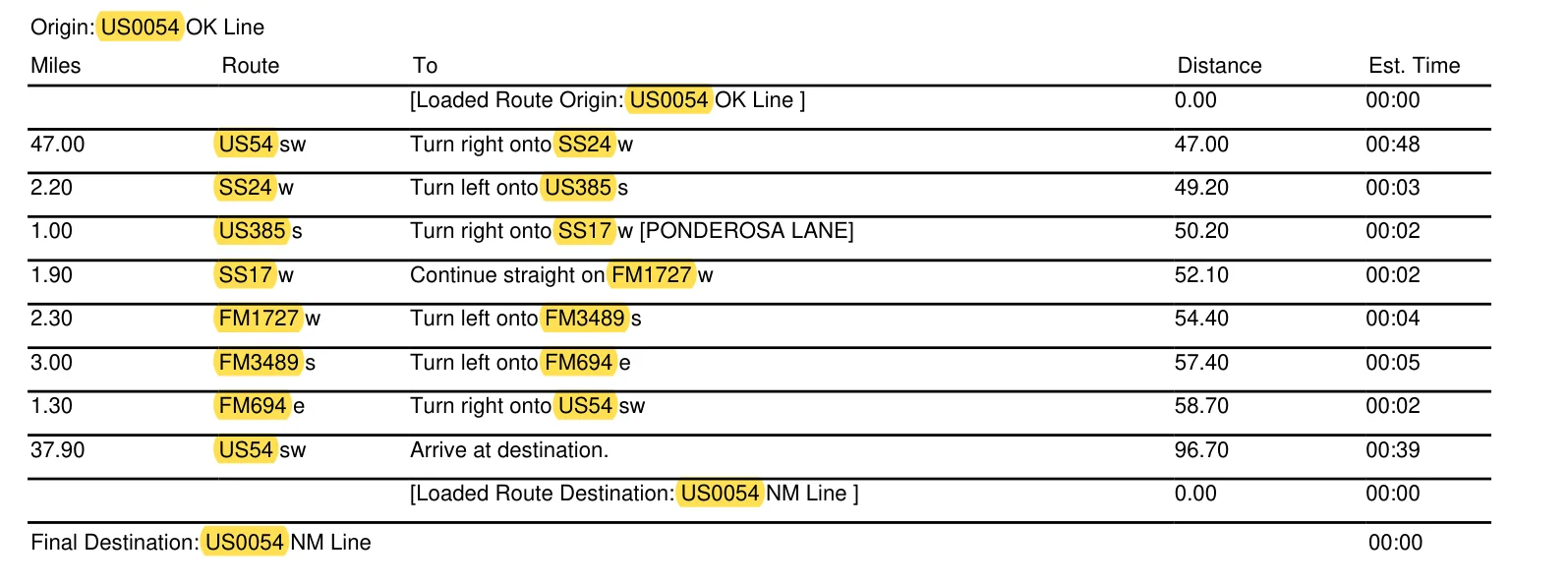
How to read the route
Read the table top to bottom, one row per stretch of road. 'Route' is the road you are on and the way you are heading: 'US54 sw' is US 54 going southwest. 'Miles' is how far you stay on it, and 'To' is the move at the end of it: the turn, ramp or exit onto the next road. 'Distance' is the running total from the start, while 'Est. Time' is the time for that one row. The rows in [brackets] at the top and bottom mark the start and end with 0.00.
Columns, left to right: Miles · Route · To · Distance · Est. Time.
What's on each page
- Page 1: Permit holder, valid dates, load and sizes, truck, the start and end under 'Route Description', a 'Route Conditions' box when there are local rules, the first General Conditions, and the fees.
- Page 2: General Conditions continued: bridges, staying on the route, city and county roads, day and night travel, equipment, and leaving the route for fuel or food.
- Page 3: The last General Conditions (trees, railroad crossings), then the route table with Miles, Route, To, Distance and Est. Time, ending with the Final Destination line. On a long trip the table continues on page 4.
Road names on Texas permits
| On the permit | Means |
|---|---|
| IH35 | Interstate 35 |
| US54 | U.S. Highway 54 |
| US0054 | U.S. Highway 54, written with zeros in the start and end lines |
| SH43 | State Highway 43 |
| FM1727 | Farm to Market Road 1727 |
| SS24 | State Spur 24 |
| SL256 sw [LOOP 256] | State Loop 256, heading southwest |
| IH35WFR | The west frontage road (service road) of Interstate 35 |
Where the route starts and ends
Page 1 lists the ends under 'Route Description' as 'Origin:' and 'Destination:', and the route table repeats them in [brackets] on its first and last rows. A start or end at the state line is the road plus the neighbor state: 'US0054 OK Line' is US 54 at the Oklahoma line, and 'IH0030 AR Line' is I-30 at the Arkansas line. A point inside Texas is written as a road and a distance from where two roads meet, in the form '<road>, <miles>mi <direction> of <road> & <road>'.
Conditions to watch for
Travel time
Move in daytime only, unless the Route Conditions or General Conditions say otherwise.
“Daytime movement only unless otherwise specified under Route Conditions or General Conditions.”
Night on Interstates
Loads up to 10 ft wide, 14 ft high and 100 ft long, with legal overhangs, may run at night on Interstates with no escorts. Overweight-only loads may also run at night. Both of our sample loads were 11 ft wide or more, so this did not apply to them.
“may travel at nighttime on the Interstate Highway System with no escorts required.”
Local curfews
Check the 'Route Conditions' box on page 1. One of our permits had a Buffalo city curfew on US 79 and four other roads, weekdays 7 to 9 AM and 11 AM to 1:30 PM. The other permit had no Route Conditions box. The last page says overweight-only loads are exempt from curfew.
“City of Buffalo Curfew: No permits on the following highways within Buffalo City limits”
Stops for fuel and food
You may leave the route for food, fuel, repair or rest if the entrance is within 1 mile of the nearest ramp or intersection and you will not pass under or over any structure.
“having an entrance within one mile of the nearest ramp or intersection”
City streets and county roads
The permit covers state roads only. Directions it gives on city streets or county roads are for information; you need local approval to use them.
“This permit does not authorize travel on non-state maintained roadways (i.e., city streets and county roads).”
Toll roads
One of our two permits said no toll roads unless the route lists one or the toll authority gives you written permission. The other permit did not have this line.
“Travel is not authorized on toll roads unless the permit route explicitly includes a toll road”
Keep it in the truck
Carry the permit, with all its pages, until one day after it expires.
“State law requires permit to be carried in vehicle until one day after expiration.”
Easy to miss
- The route is not on page 1. Page 1 only shows the start and end under 'Route Description'. The turn-by-turn table comes after General Condition 24, on the last page.
- A long route runs onto another page. Our 608-mile permit started the table on page 3 and finished it on page 4, where the header repeats and 'Est. Time' is labeled just 'Time'.
- 'Miles' and 'Distance' are different numbers. 'Miles' is that row only; 'Distance' is the running total. A row marked '< 0.1' is a very short move, usually a ramp.
- Names in [brackets] are other names for the same road, not extra turns: 'US59 sw [SOUTH LAKE DRIVE]' or 'SL1 sw [LOOP 1], [MOPAC EXPRESSWAY]'. Ramps and frontage roads get their own rows, like 'IH35WFR s' for the I-35 frontage road.
Questions
Where is the route on a Texas oversize permit?
At the end, after the numbered General Conditions. Page 1 only gives the origin and destination under 'Route Description'. The table with Miles, Route, To, Distance and Est. Time starts on the last page, or the last two pages on a long trip.
What do IH, FM, SH, SS and SL mean on a Texas permit?
IH is an Interstate (IH35 is I-35), US is a U.S. highway, SH is a State Highway, FM is a Farm to Market Road, SS is a State Spur and SL is a State Loop. WFR or NFR after a road means its west or north frontage road.
Can I drive an oversize load at night in Texas?
The permit says daytime movement only unless the conditions say otherwise. It allows night travel on Interstates, with no escorts, for loads no more than 10 ft wide, 14 ft high and 100 ft long with legal overhangs, and it lets overweight-only loads run at night.
Your permit is the legal document; follow everything it says. Permits change, and yours may differ from the ones we read.Last checked October 2026.